The choice between an Iran eVisa and Visa on Arrival depends on cost, time, and risk tolerance. The eVisa offers advance approval and peace of mind, while Visa on Arrival lets you skip the online application but carries rejection risk at the border, particularly if the request is considered high risk by Iranian authorities.
Overview: Iran eVisa and Visa on Arrival Explained
Both options let eligible travellers enter Iran for tourism, but they differ fundamentally in how and when approval is granted. The Iran eVisa functions as a pre-travel electronic authorisation that UK tourists apply for online before departure, submitting the application through the Iranian Ministry of Foreign Affairs eVisa portal (evisa.mfa.ir).
Conversely, the Visa on Arrival is a visa issued at major Iranian airports upon arrival. UK passport holders can obtain the Visa on Arrival at specific airports: Tehran IKA, Shiraz, Mashhad, Isfahan, and Kish Island. Eligibility varies by nationality; UK citizens should verify their status before travel.
Cost Comparison: eVisa vs Visa on Arrival
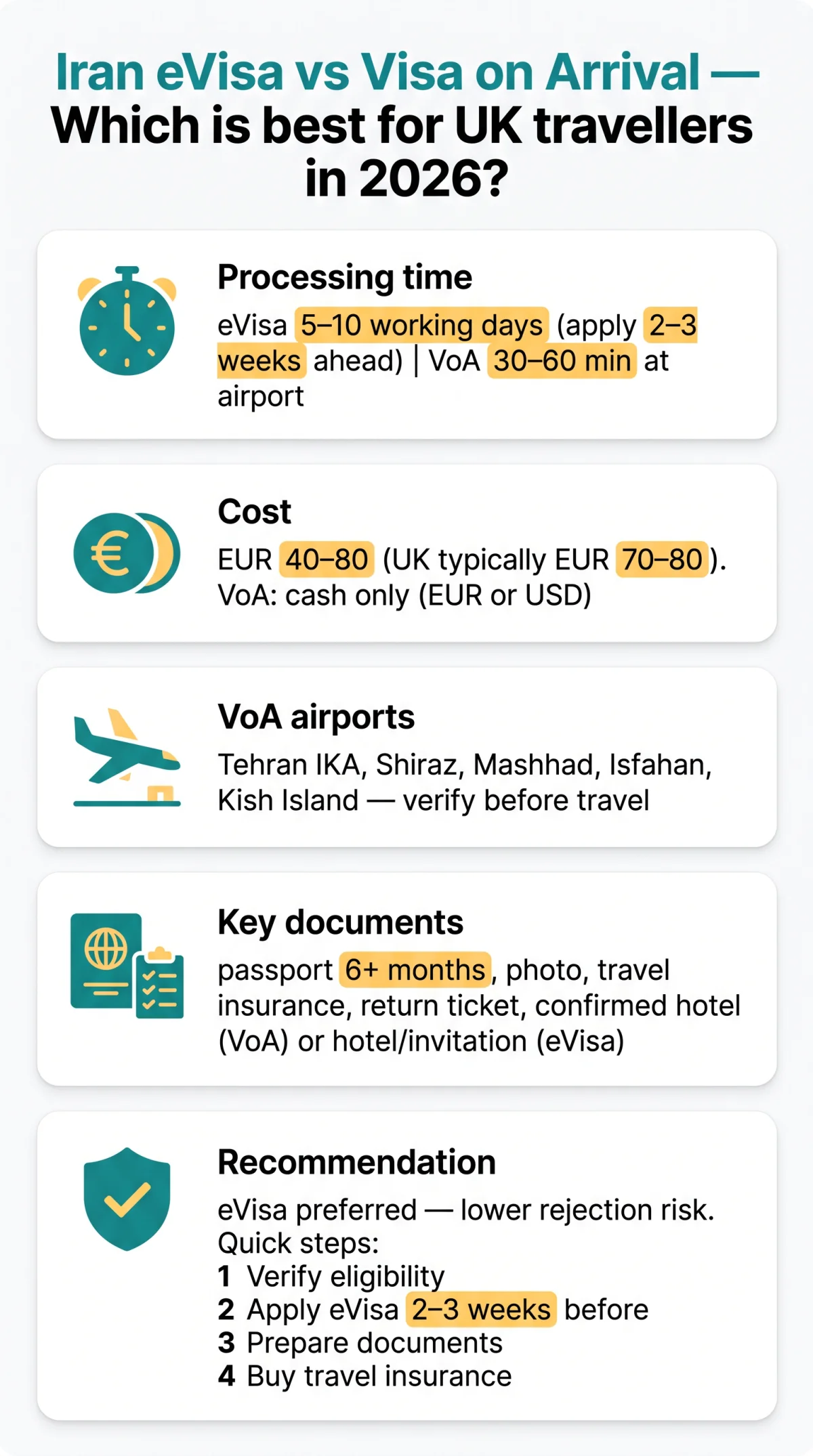
Costs are broadly similar (EUR 40 to 80 for both), but hidden fees and exchange rate differences can tip the balance: the eVisa may incur agency fees, while VoA requires exact cash in EUR or USD and rejects Iranian currency.
| Cost Factor | Iran eVisa | Visa on Arrival |
|---|---|---|
| Base fee | EUR 40 to 80 (depends on nationality and visa type) | EUR 40 to 80, payable at the airport |
| Payment method | Online payment via portal | Cash only: EUR or USD; Iranian currency not accepted |
| Additional fees | Possible service or agency fees when using third-party assistance | No third-party fees, but exchange rate differences may apply |
| UK passport holders | Typically fall in the EUR 70 to 80 bracket per MFA fee schedule | Same bracket; verify current rate at the airport counter |
| Travel insurance | Separate cost: mandatory | Separate cost: mandatory |
Processing Time: How Long Does Each Option Take
Iran eVisa vs Visa on Arrival: the eVisa requires planning ahead with a multi-day processing window, while the Visa on Arrival is issued on the spot at the airport, if approved.
The Iran eVisa typically takes 5 to 10 working days to process, though delays can occur during peak travel periods or for certain nationalities. UK travellers should apply at least 2 to 3 weeks before departure to allow sufficient time. This advance processing gives the eVisa a clear advantage: you know whether you are approved before you board your flight.
By contrast, the Visa on Arrival is issued at the airport within 30 to 60 minutes upon arrival. However, wait times can stretch longer during busy periods, and there is no guarantee of approval. The eVisa provides pre-departure certainty, while the Visa on Arrival risks rejection after landing if the request is considered high risk, as per rejection grounds cited by Iranian authorities.
Requirements for Each Visa Option
Documentation requirements overlap but differ in key areas such as advance hotel booking and invitation letters.

- Iran eVisa requires a passport scan with 6+ months validity, a digital photo, a completed online form, travel insurance, a hotel booking or invitation letter, and return flight details.
- Visa on Arrival requires a valid passport with 6+ months validity, one passport photo, the visa fee in cash, a return ticket, a confirmed hotel booking, and travel insurance.
- UK citizens may need a guide or special authorisation regardless of visa type.
- Some nationalities are ineligible for Visa on Arrival entirely.
The eVisa accepts an invitation letter as an alternative to a hotel booking, whereas Visa on Arrival demands a confirmed hotel booking with no substitute document.
Pros and Cons of Iran eVisa vs Visa on Arrival
| Option | Pros | Cons |
|---|---|---|
| Iran eVisa | Advance approval before departure, no airport queue, lower rejection stress, smoother entry | Longer lead time, online portal can be unreliable, requires digital documents |
| Visa on Arrival | No advance application, flexible timing, convenient for last-minute trips | Rejection risk at border, airport wait, cash payment required, limited airport entry points |
The decision hinges on risk tolerance: Visa on Arrival risks an immediate return flight if rejected because the request is considered high risk.
Which Option Should UK Travellers Choose in 2026
For most UK passport holders, the Iran eVisa is the safer choice due to lower rejection risk and advance confirmation. The eVisa lets you secure entry approval before leaving the UK, whereas the Visa on Arrival can be rejected at the airport because the request is considered high risk.
Check current eligibility
Verify your status on the Iranian MFA eVisa portal.
Apply for eVisa in advance
If eligible, apply at least 2 to 3 weeks before departure.
Verify VoA availability if time is short
Check Visa on Arrival availability for UK citizens at your arrival airport.
Prepare all documents in advance
Gather everything you need regardless of which option you choose.
Purchase travel insurance covering Iran
The political situation can change rapidly, so always verify with recent traveller reports and the FCDO travel advice.
Always double-check eligibility and fees at: Iran MFA eVisa portal | UK FCDO Iran travel advice. This article was published in 2026. Entry regulations change frequently; confirm with official sources before booking.
FAQ
Can UK citizens get a Visa on Arrival for Iran in 2026?
UK citizens must verify their eligibility for a Visa on Arrival with Iranian government sources before travelling. Entry regulations can change rapidly, and UK nationals frequently face higher scrutiny, making advance approval via the eVisa a safer alternative.
How much does the Iran eVisa cost for UK passport holders?
Data from the MFA portal indicates a range of EUR 40 to 80; UK citizens typically fall in the EUR 70 to 80 bracket for a single-entry, 30-day stay. Consult the eVisa portal for the most up-to-date fee structure.
Is the Iran eVisa portal reliable for online applications?
The portal is the designated channel for online applications, but users sometimes report technical issues. Apply well in advance and ensure all documentation strictly meets the specified requirements to avoid processing delays or unexpected rejections.
What happens if my Visa on Arrival is rejected at the Iranian airport?
If your Visa on Arrival is rejected at the border, you will be denied entry and required to return to your departure point immediately at your own expense. This highlights the inherent risk of choosing this option over securing an eVisa in advance.
Can I enter Iran through any airport with a Visa on Arrival?
Visas on Arrival are limited to specific international airports: Tehran IKA, Shiraz, Mashhad, Isfahan, and Kish Island. Confirm the current list of designated entry points with Iranian immigration authorities before booking flights, as eligible airports may change without prior notice.
Do I need travel insurance for both Iran eVisa and Visa on Arrival?
Yes. Travel insurance is mandatory for entry into Iran under both the eVisa and Visa on Arrival processes. Verify the exact coverage stipulations with official sources prior to your travel.
How long can I stay in Iran with an eVisa or Visa on Arrival?
Both the eVisa and Visa on Arrival typically grant a 30-day stay for tourism purposes. Consult the Iranian embassy or the immigration portal for precise validity periods and ensure you comply with all limits.
Can I extend my Iran visa after arrival regardless of which option I chose?
Visa extension policies in Iran are subject to immigration regulations. While extensions are sometimes possible, you must confirm the specific rules and procedures with local authorities or government portals after your arrival to avoid overstaying your permitted duration.