The eVisa Iran is a digital travel authorisation issued by the Iranian Ministry of Foreign Affairs via the portal at evisa.mfa.ir. UK passport holders always require a visa and should expect processing times exceeding 6 weeks. The standard service fee is EUR 36 for most nationalities; UK passport holders pay £85. The eVisa Grant Notice is valid for 1 month from issue.
Last updated: 8 September 2026. This is an independent information service and is not affiliated with the Iranian Ministry of Foreign Affairs, FCDO, or any embassy. We do not process visa applications and do not accept payments for visas.
The Iran eVisa is an electronic travel authorisation that allows eligible travellers, including UK citizens, to apply for a tourist visa online via the Iranian MFA portal. Processing takes 7-10 working days (or 6+ weeks for British passports). The standard fee is EUR 36 for most nationalities; UK applicants pay £85. A valid passport with at least 6 months’ validity beyond the intended departure date is required.
What Is the Iran eVisa?
The Iran eVisa is a digital MFA authorisation, replacing sticker visas for most nationalities. Apply at evisa.mfa.ir, where the entire process – from form completion to fee payment and status tracking – takes place online.
The eVisa Iran differs from the Visa on Arrival (VoA), which requires advance registration at least 2 days prior to travel and is issued only at Iranian international airports upon arrival. Several visa sub-types are available through the eVisa system in 2026: the tourist visa (Type B), business, transit, medical, and pilgrimage (Ziarat) categories. The Iran eVisa tourist visa authorisation window is 3 months (90 days) from the date of issue.
Who Needs an Iran eVisa and Eligibility Criteria
Most foreign nationals need an Iran eVisa; UK citizens always require a visa, while exempt nationalities include Turkey (90 days), China (21 days), and Armenia (90 days). The eVisa Iran requires applicants to hold a passport valid for at least 6 months beyond the intended departure date, with at least one blank page. British citizens always require a visa.
| Country | Allowed Stay | Conditions |
|---|---|---|
| Turkey | 90 days within 180 days | Ordinary passport holders |
| Armenia | 90 days within 180 days | Ordinary passport holders |
| Oman | 90 days within 180 days | Ordinary passport holders |
| Syria | 90 days within 180 days | Must enter Iran by air |
| Russia | 90 days within 180 days | Tour groups of 5-50 persons with tour operator representative |
| Georgia | 45 days | Ordinary passport holders |
| Iraq | 30 days | Ordinary passport holders |
| Tajikistan | 30 days | Must depart Dushanbe and arrive at IKA Tehran |
| China (PRC) | 21 days | PRC passports only |
| Hong Kong | 21 days | Hong Kong SAR passports only |
| Macau | 21 days | Macau SAR passports only |
| Egypt | 20 days | Ordinary passport holders |
| Venezuela | 15 days within 180 days | Extendable up to 90 days |
| Belarus | 15 days within 180 days | Tourism only; non-extendable; once every 6 months |
| Bahrain, Bosnia and Herzegovina, Brazil, Brunei, Cambodia, Croatia, Cuba, India, Indonesia, Japan, Kuwait, Kyrgyzstan, Lebanon, Mauritania, Mauritius, Mexico, Peru, Qatar, Saudi Arabia, Serbia, Seychelles, Singapore, Tanzania, Tunisia, UAE, Uzbekistan, Vietnam, Zimbabwe | 15 days within 180 days | Tourism purposes only |
| Azerbaijan | 14 days | Ordinary passport holders |
| Kazakhstan | 14 days | Bilateral agreement; 15 days under 2024 unilateral tourism exemption |
| Malaysia | 14 days | Ordinary passport holders |
UK, US, and Canadian citizens face extended processing of more than 6 weeks and higher fees of £85 (standard) or £128 (urgent). US citizens must travel with a guide escort and provide additional documentation. According to iranianvisa.com data, UK passport holders account for 19.7% of applications with a 96% approval rate. Biometric fingerprinting may be required at the London consulate or at airport arrival for UK/US/CA passport holders.
Israel Passport Stamps and Iran eVisa Stamping Policy
The eVisa Iran does not carry a published blanket ban on travellers holding Israeli passport stamps, but applications face elevated refusal risk at the border. Iranian border control may inspect passport stamps, and dual nationals with Israeli ties face additional scrutiny. A second passport, where legally held, is a practical workaround. Apply well in advance and be prepared for potential refusal if the passport contains Israeli stamps.
Separately, since June 2019 – following the ICHTO announcement of November 2018 – most nationalities receive no physical visa sticker or entry/exit stamps in their passports. The policy rationale is a response to US banking sanctions affecting persons who have visited Iran. Entry and exit are recorded electronically, linked to the passport number.
However, UK, US, and Canadian citizens may still receive physical stamps. The Iran eVisa Grant Notice and all payment receipts should be retained throughout the trip as proof of legal entry, particularly for these exempted nationalities.
Documents Required for the Iran eVisa Application
The Iran eVisa application requires the following documents:
- Passport copy: colour scan of the biographical data page, max 10 MB, PDF or JPG format, complete and readable copy of the front page.
- Digital photograph: recent, face against a plain light background, max 10 MB.
- Female photo dress code: hijab not required in upload photo; dress code applies in Iran only.
- Travel itinerary: flight booking or intended travel dates.
- Accommodation proof: hotel reservation or host invitation letter.
- Invitation letter: required if applicable (family or business visits).
- Proof of travel insurance: valid policy covering the stay in Iran.
- Valid email address: authenticated throughout the entire Iran eVisa process.
- Payment method: for the visa service fee.
- Consulate collection documents: 2 recently taken passport-size photos, completed application form, valid passport, visa fee, and the authorisation reference code received by email from the Foreign Ministry (per uk.mfa.gov.ir).
How to Apply for the Iran eVisa Online – Step by Step
The eVisa Iran application is submitted at evisa.mfa.ir: account creation, form completion, document upload, payment, and Grant Notice receipt via email.
Visit the portal
Go to evisa.mfa.ir and select “Apply for Visa”.
Create account
Register at evisa.mfa.ir using a valid email; you will receive an authentication code to verify the account.
Fill personal details
Enter name, DOB (DD/MM/YYYY), nationality, passport number, occupation, father’s name, place of birth.
Upload documents
Attach passport scan (max 10 MB) and photograph (max 10 MB, plain light background).
Enter trip details
Provide arrival date, port of entry, purpose, accommodation, plus UK and Iran addresses and phone numbers.
Submit
Review and submit to receive your visa application reference number.
Pay the fee
Complete the visa fee payment.
Wait and track
Track status at evisa.mfa.ir using email or reference number.
Receive Grant Notice
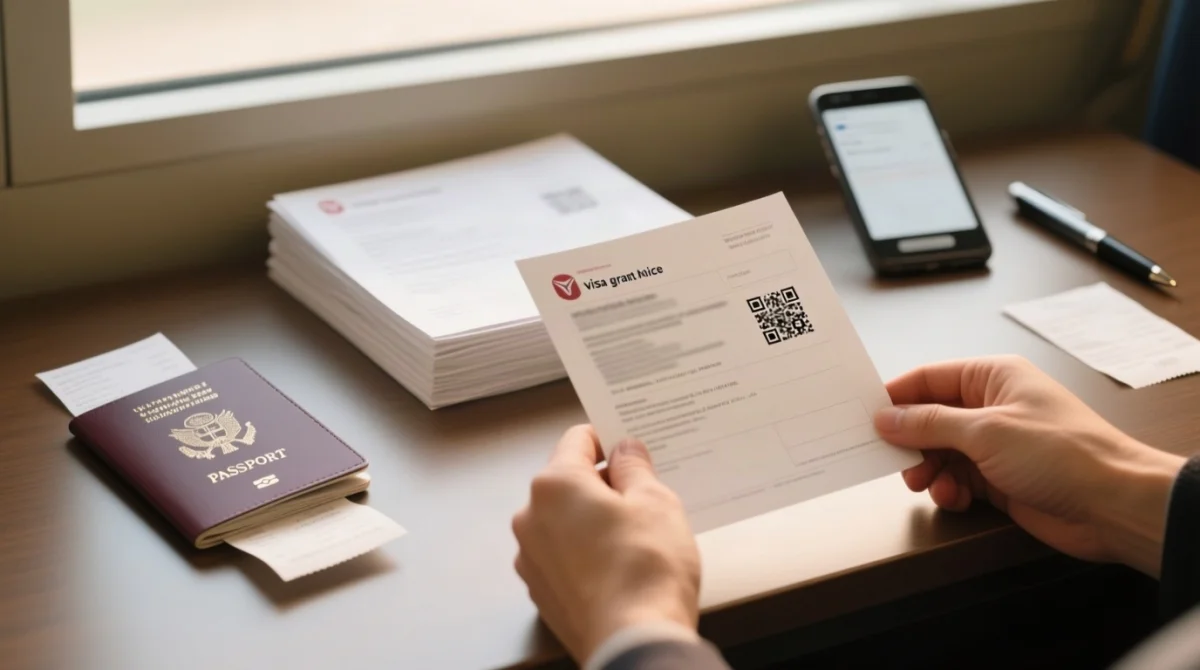
The Iran eVisa Grant Notice (PDF) arrives via email, valid for 1 month. It features a QR code, visa number (IR- + 11 digits), 18-character tracking code, barcode, Visa Stamp Fee Seal, and photograph. Print at least 2 copies and present at the port of entry. Optional consular forwarding of the Grant Notice costs an additional fee (not specified on evisa.mfa.ir; confirm at collection).
Iran eVisa Fees, Costs and Payment Methods
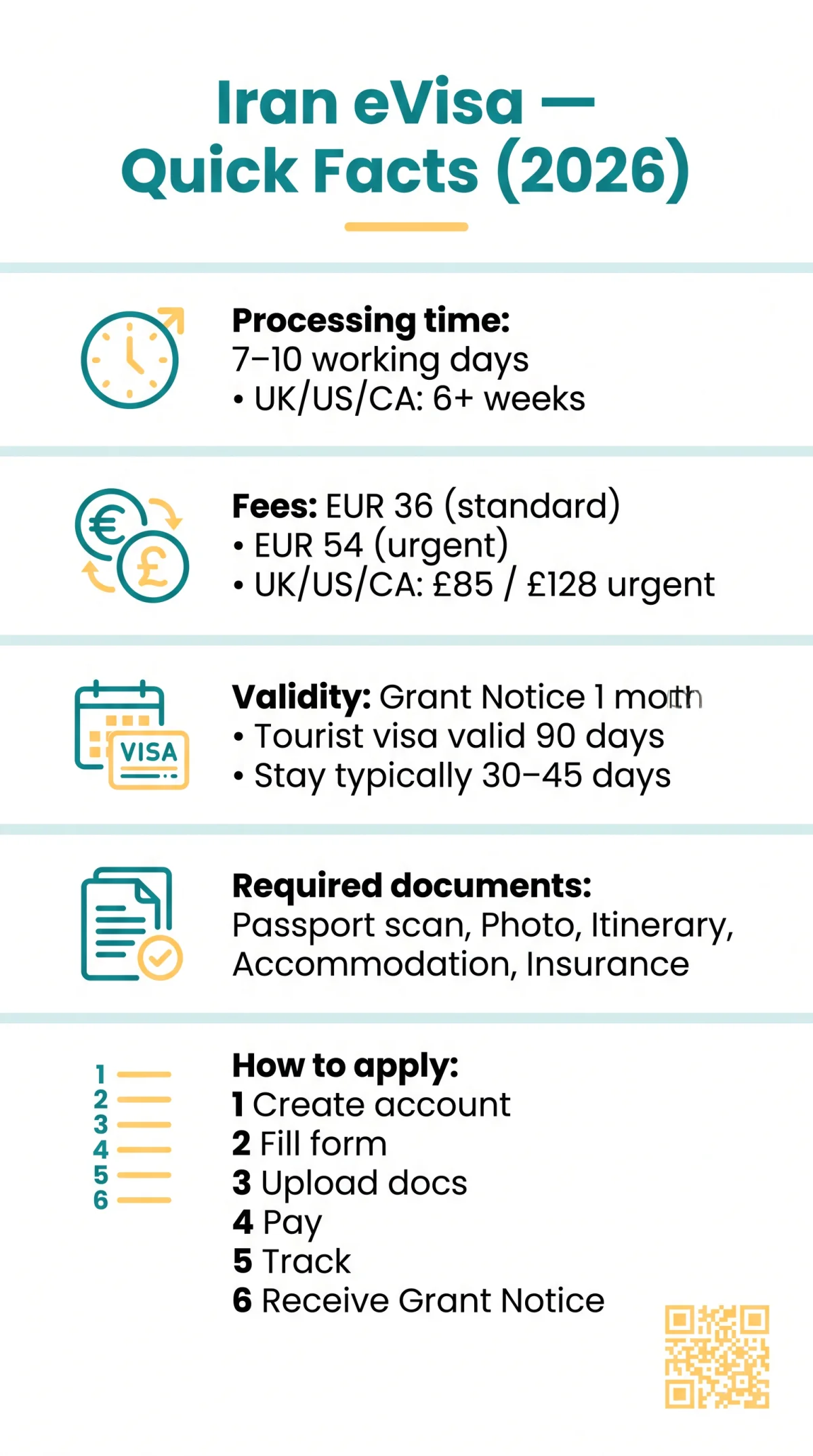
The Iran eVisa standard service fee is EUR 36 for most nationalities; urgent processing costs EUR 54. UK/US/Canada applicants pay £85 / US$122 (standard) or £128 / US$182 (urgent). The consular stamping fee is a separate charge, payable at the consulate or upon entry. An optional Grant Notice forwarding service incurs an extra charge. Verified against evisa.mfa.ir on 8 September 2026.
| Application Type | Standard Fee | Urgent Fee |
|---|---|---|
| Most nationalities | EUR 36 | EUR 54 |
| UK / US / Canada | £85 / US$122 | £128 / US$182 |
International Visa and Mastercard cards are blocked in Iran due to banking sanctions. The consular fee at the London consulate requires cash only in GBP or EUR. For in-country spending, travellers must carry EUR and USD in clean notes, use tourist prepaid debit cards like MahCard and Daric loaded before arrival, or purchase Iranian bank cards (TAP) at airports. International cards do not work at Iranian ATMs.
Iran eVisa Processing Times and Validity
Standard Iran eVisa processing takes 7-10 working days; UK, US, and Canadian citizens should expect 6+ weeks due to additional screening.
| Application type | Processing time |
|---|---|
| Standard (most nationalities) | 7-10 working days |
| Urgent (additional fee) | 3-5 working days |
| UK / US / Canada passport holders | More than 6 weeks (up to 8 weeks) |
| Consular turnaround after authorisation code | 1-2 days |
UK citizens should apply at least 3 months before planned travel. Delays stem from incomplete applications, Iranian public holidays, additional documentation requests, and seasonal volumes around Nowruz (20-21 March).
The Iran eVisa Grant Notice is valid for 1 month from the date of issue – travellers must enter Iran within this window. The tourist visa (Type B) validity period is 3 months (90 days) from the date of issue. Permitted stay on entry is typically 30-45 days, extendable in-country up to 90 days at the Police Department of Foreign Aliens Affairs in major cities, with processing taking 1-3 working days. Overstay penalties include fines and complications on future entries.
Visa on Arrival vs. eVisa and Land Border Entry
The eVisa Iran provides pre-travel approval certainty, while Visa on Arrival (VoA) requires advance online registration at least 2 days before arrival and is obtainable at all Iranian international airports. UK citizens: eVisa requires consular collection in London; VoA avoids this but offers no pre-travel approval. Choose based on whether you prefer certainty (eVisa) or last-minute flexibility (VoA).
| Feature | Iran eVisa | Visa on Arrival | Embassy Visa |
|---|---|---|---|
| Application location | Online at evisa.mfa.ir | Iranian international airports | Consulate in London |
| Advance registration | Required | Required, at least 2 days prior via MFA portal | Required |
| Approval certainty | Before travel | At the border | Before travel |
| Best for | Planned trips, no airport queues | Last-minute travel | Complex cases, restricted nationalities |
VoA is available at all Iranian international airports, including IKA Tehran, Isfahan, Shiraz, Tabriz, Mashhad, Kish, and Bandar Abbas. Self-transfer passengers transiting Tehran Airport (IKA) without leaving the transit area do not require a transit eVisa; those passing through immigration do. The Iran eVisa Grant Notice is generally accepted at major land border crossings: Turkey (Bazargan/Maku, Gürbulak), Armenia (Nordooz/Agarak), Azerbaijan (Astara, Biləsuvar), Iraq, Turkmenistan (Bajgiran, Sarakhs), and Pakistan (Taftan). VoA at land borders is more limited than at airports, and advance registration remains mandatory.
| Entry Point | Type | eVisa Accepted | VoA Available |
|---|---|---|---|
| IKA Tehran, Isfahan, Shiraz, Tabriz, Mashhad, Kish, Bandar Abbas | Airport | Yes | Yes |
| Bazargan/Maku, Gürbulak (Turkey) | Land border | Generally yes | Limited |
| Nordooz/Agarak (Armenia) | Land border | Generally yes | Limited |
| Astara, Biləsuvar (Azerbaijan) | Land border | Generally yes | Limited |
| Bajgiran, Sarakhs (Turkmenistan) | Land border | Generally yes | Limited |
| Taftan (Pakistan) | Land border | Generally yes | Limited |
Verify eVisa acceptance with the specific border post before travel.
Iran eVisa Travel Insurance and FCDO Advisory for UK Travellers
The Iran eVisa requires every applicant to present proof of valid travel insurance at the port of entry. Standard UK travel insurance policies almost universally exclude Iran due to the FCDO advisory and international sanctions.
As of September 2026, the UK FCDO advises against all travel (or all but essential travel) to Iran. This advisory level triggers exclusions in most standard policies, requiring travellers to seek specialist insurers such as Campbell Irvine, Battleface, or World Nomads (verify current availability). Minimum recommended coverage: £1 million medical expenses, repatriation, and trip cancellation.
Some insurance policies are available at Iranian airport arrival points, though reliability varies. Travellers should verify that their policy covers Iran by name, confirm medical and repatriation cover, and carry a printed policy document.
There has been no British Embassy in Tehran since 2011, limiting consular assistance. UK interests are handled via the Swedish Embassy in Tehran, with FCDO travel advice helpline support available. Check the latest FCDO advisory at gov.uk/foreign-travel-advice/iran. Mandatory passport registration is required for Iranian SIM cards; messaging apps and VPN usage may be restricted.
Iranian Consulate in London – Visa Collection Details
The Iranian Consulate visa section is at 50 Kensington Court, London W8 5DD, United Kingdom, open Monday-Wednesday 09:00-12:00, with email-only contact at [email protected]. UK travellers collecting an approved Iran eVisa must visit this address in person or arrange a third-party visa collection service.
Practical note: The visa section opens at 09:00, and card payments are not accepted. Applicants without cash are turned away. Arrive by 08:45 to avoid queues.
Applicants must bring: a valid passport, the printed Iran eVisa Grant Notice, cash for the consular stamping fee (GBP or EUR only – cards are not accepted), 2 recently taken passport-size photos, the completed application form, and the authorisation reference code received by email from the Ministry of Foreign Affairs.
Phone: +44 (0)20 7225 3000 (email preferred). The Consular Section can also be reached at [email protected].
For complex cases, the Embassy of Iran is located at 16 Princes Gate, London SW7 1PT (phone: +44 (0)20 7225 4200; email: [email protected]). Arrive early on collection days; if an in-person visit is difficult, consider using registered post.
Sources: evisa.mfa.ir (accessed 8 September 2026); uk.mfa.gov.ir (accessed 8 September 2026); gov.uk/foreign-travel-advice/iran (accessed 8 September 2026); ICHTO announcement, November 2018; iranianvisa.com (accessed 8 September 2026).
Iran eVisa FAQ: Key Questions Answered for UK Travellers
Can UK citizens apply for the Iran eVisa entirely online?
No. UK citizens cannot apply entirely online – consular collection in London is mandatory. See “Iranian Consulate in London” section above for full details.
How long does Iran eVisa processing take for UK passport holders?
UK passport holders should expect more than 6 weeks, sometimes up to 8 weeks, due to additional security screening. Standard processing for most other nationalities takes 7-10 working days, with an urgent option at 3-5 working days. Apply at least 3 months before planned travel.
What is the difference between the Iran eVisa Grant Notice validity and the tourist visa validity?
The eVisa Grant Notice is valid for 1 month from issue (must enter Iran within this window). The tourist visa (Type B) validity is 3 months (90 days) from issue. Permitted stay on entry is typically 30-45 days, extendable in-country up to 90 days.
Do UK passport holders receive passport stamps when entering Iran?
Yes. Since June 2019, Iran operates a paperless eVisa system with no stamps for most nationalities, but UK, US, and Canadian citizens are exceptions and may still receive physical stamps.
Can I enter Iran with an Israeli stamp in my passport?
Iran does not formally ban Israeli stamps, but refusal risk is high. Iranian border control may check passport stamps. Apply well in advance and be prepared for potential refusal. A second passport, where legally held, is a practical workaround.
Will my UK bank card work in Iran for paying the consular visa fee?
No. International Visa and Mastercard cards do not work in Iran or at Iranian diplomatic missions due to banking sanctions. The consular fee at the Iranian Consulate in London must be paid in cash only, in GBP or EUR. For spending inside Iran, carry EUR or USD cash or use tourist prepaid cards such as MahCard or Daric.
Is travel insurance mandatory for entering Iran on an eVisa?
Yes. Iran requires proof of valid travel insurance at the port of entry. Standard UK policies exclude Iran due to the FCDO advisory and sanctions. UK travellers need a specialist insurer covering Iran by name, with minimum recommended coverage of £1 million for medical expenses and repatriation. Carry a printed policy document.
Can I extend my Iran eVisa stay beyond the initial permitted duration?
Yes. The tourist visa (Type B) permits an initial stay of 30-45 days, extendable in-country up to 90 days. Extensions are handled by the Police Department of Foreign Aliens Affairs in major Iranian cities. Processing takes 1-3 working days. Overstay penalties include fines and complications on future entries.
Can I use the Iran eVisa Grant Notice at land border crossings or only at airports?
The eVisa Grant Notice is generally accepted at major land border crossings, including Bazargan (Turkey), Nordooz (Armenia), and Astara (Azerbaijan), as well as at all Iranian international airports. Verify eVisa acceptance with the specific border post before travel. VoA is available at airports with advance registration of at least 2 days, but is more limited at land borders.
What should I bring to the Iranian Consulate in London for visa collection?
Bring your valid passport, printed eVisa Grant Notice, cash for the consular stamping fee in GBP or EUR, 2 recently taken passport-size photos, completed application form, and authorisation reference code. The consulate is at 50 Kensington Court, London W8 5DD, open Monday-Wednesday 09:00-12:00. Contact by email at [email protected].