Last updated: 8 September 2026. Fee and processing data verified against the Iranian MFA eVisa portal (evisa.mfa.ir) and cross-referenced with consular sources. This guide is maintained by a UK-based travel editorial team specialising in Iran visa procedures for South Asian nationals. Always confirm current requirements with the Iranian embassy before applying.
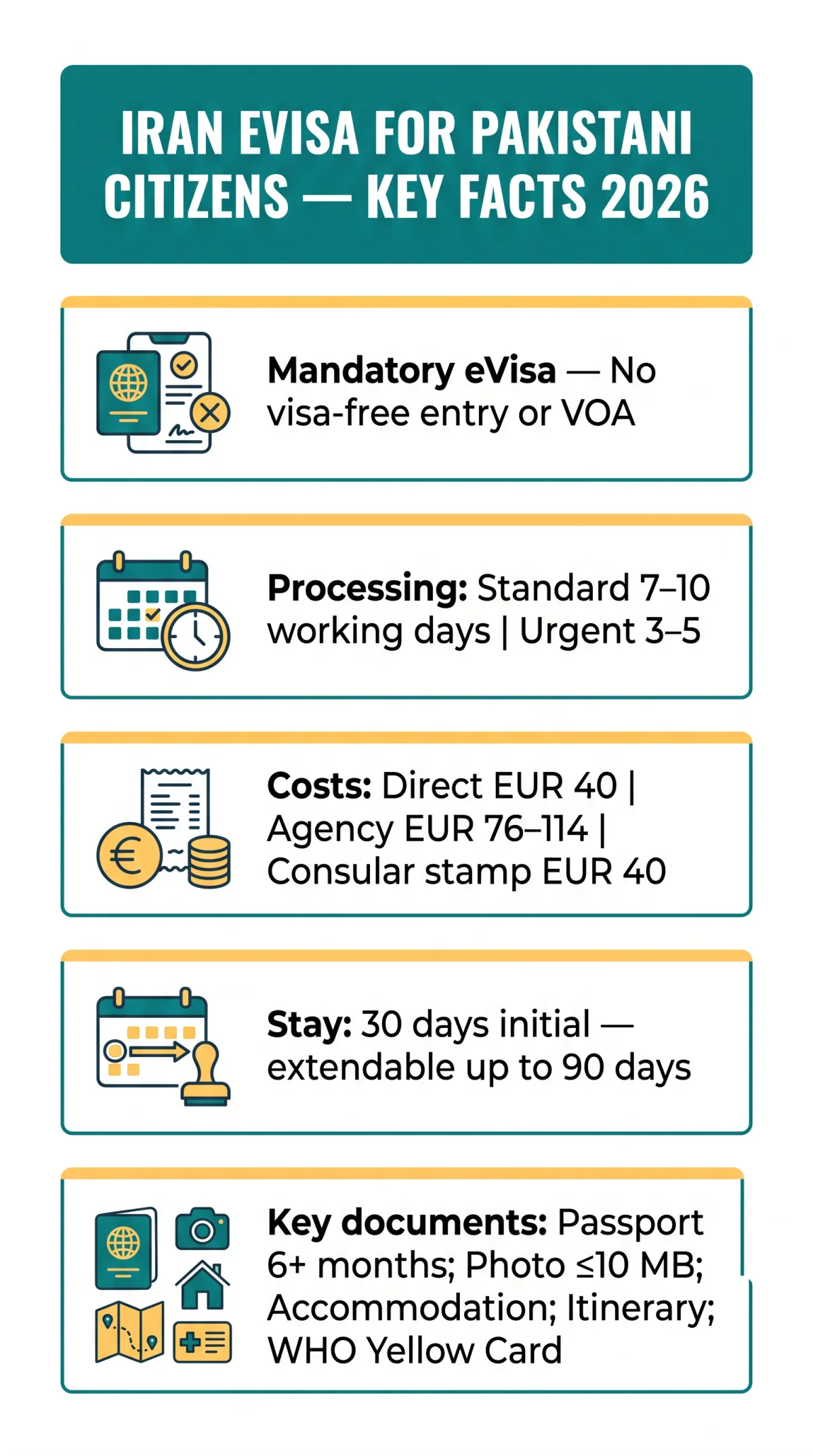
Iran eVisa for Pakistani citizens requires a valid passport with at least 6 months validity beyond the travel date, a digital photo, travel itinerary, and accommodation proof. Pakistani passport holders are not eligible for visa-free entry or visa on arrival, making the eVisa mandatory for all travel to Iran. Apply online via the Iranian MFA eVisa portal at evisa.mfa.ir, pay a EUR 40 consular stamp fee, and collect your visa at an Iranian consulate in Pakistan. Standard processing takes 7 to 10 working days.
Do Pakistani Citizens Need a Visa for Iran? 2026 Policy Context
The Iran eVisa for Pakistani citizens is mandatory – no visa-free entry and no visa on arrival (VOA) apply to Pakistani ordinary passport holders at any Iranian border or airport.
The Type B tourist visa grants a 30-day initial stay, extendable to 90 days at the Police Department of Foreign Aliens Affairs. The eVisa and traditional consulate visa share this classification; the difference is submission: online via the Iranian MFA portal vs in-person from the start.
Since January-February 2026, MFA policy changes have caused longer processing times and significantly lower approval rates for the Iran eVisa for Pakistani applicants. Travellers should factor this tightened environment into their planning timeline.
- No visa-free entry for Pakistani ordinary passport holders
- No visa on arrival (VOA) at any Iranian point of entry
- Type B tourist visa – 30 days initial, up to 90 days extendable in-country
Visa Requirements for Pakistani Passport Holders
Iran eVisa requirements for Pakistani applicants: passport valid 6+ months beyond travel date (shorter validity auto-blocks the application), digital photo (≤10 MB, plain light background), accommodation proof, and travel itinerary. The issued eVisa is valid for 90 days from date of issue, with an initial 30-day stay, extendable to 90 days in-country. A multiple-entry option is available.
Passport Validity and Photo Specifications
Photo: face on plain light background, ≤10 MB. Passport copy: readable front page scan, ≤10 MB. Both mandatory at submission. The Iran eVisa for Pakistani applicants demands strict document compliance – the MFA portal automatically blocks applications with passport validity below 6 months.
Supporting Documents: Accommodation, Itinerary & Residence Permit
Applicants must provide accommodation proof (hotel booking or host invitation) and a travel itinerary. Pakistani citizens applying from outside Pakistan – e.g., those residing in the UK – must upload a residence permit copy (BRP or eVisa share code): mandatory, max 1 file, ≤10 MB. This is critical for the Iran eVisa for Pakistani applicants in the UK.
Health and Vaccination Requirements
Pakistani travellers need a WHO Yellow Card (polio vaccination) – exit requirement enforced when departing Pakistan.
| Document | Requirement | File Size | Notes |
|---|---|---|---|
| Passport | Valid ≥ 6 months beyond travel date | N/A (physical) | System auto-blocks shorter validity |
| Digital passport photo | Face on plain light background | ≤ 10 MB | Mandatory at submission |
| Passport copy (front page) | Complete, readable scan | ≤ 10 MB | Mandatory at submission |
| Residence permit copy | Mandatory if applying outside Pakistan (e.g., UK BRP/eVisa share code) | ≤ 10 MB, max 1 file | Critical for Pakistanis applying from the UK |
| Accommodation proof | Hotel booking or host invitation | N/A | Required during application |
| Travel itinerary | Detailed plan of stay | N/A | Confirms purpose of travel |
| WHO Yellow Card | Polio vaccination certificate | N/A (physical) | Exit requirement from Pakistan |
How to Apply: Step-by-Step Process for Pakistani Citizens
The Iran eVisa for Pakistani citizens involves six steps: online registration on evisa.mfa.ir to physical visa collection at a Pakistani consulate.

Registering on the eVisa Portal and Uploading Documents
Register on the eVisa portal
evisa.mfa.ir – email authentication required throughout
Complete the form
Pakistani passport data, upload photo (≤10 MB), passport copy (≤10 MB), itinerary, accommodation proof
Pay the service fee
EUR 36 (standard) or EUR 54 (urgent) via agency; government portal charges no service fee
Receiving the Authorization Code and Collecting Your Visa
Receive the Visa Grant Notice
Authorization code from MFA Tehran – valid 1 month; visa issuance takes 1-2 days after code issued
Visit the consulate
One of five in Pakistan (Islamabad, Karachi, Lahore, Peshawar, Quetta); pay EUR 40 stamp fee + 50% surcharge for urgent
Collect your eVisa
QR code, visa number “IR-” + 11 digits, 18-character tracking code; print and carry throughout trip
Direct Portal vs Agency – A Balanced Comparison
The government portal at evisa.mfa.ir is free but offers no live support. IranianVisa.com charges EUR 36 (standard) or EUR 54 (urgent) as an agency service fee and is not affiliated with the Iranian government. The Iran eVisa for Pakistani applicants can be obtained through either route; the EUR 40 consular stamp fee applies in both cases.
Fees, Costs & Visa Collection Points in Pakistan (2026)
Agency route: EUR 76-94 total (EUR 36-54 service fee + EUR 40 stamp). Direct portal: EUR 40 total (no service fee). The Iran eVisa for Pakistani citizens requires in-person collection at a consulate after the authorization code is issued.
Fee Breakdown – Standard vs Urgent vs Direct Portal
| Fee Type | Amount (EUR) | Notes |
|---|---|---|
| Agency service fee (standard) | 36 | IranianVisa.com – not government-affiliated |
| Agency service fee (urgent) | 54 | IranianVisa.com |
| Consular stamp fee | 40 | All applicants, payable at consulate |
| Urgent consulate surcharge | 60 | 50% extra on stamp fee |
| Total – standard (agency) | 76 | EUR 36 + EUR 40 |
| Total – urgent (agency) | 94 | EUR 54 + EUR 40 |
| Total – urgent + surcharge | 114 | EUR 54 + EUR 60 |
| Total – direct portal (standard) | 40 | No agency fee; stamp fee only |
Convert EUR to PKR using the current exchange rate at time of application.
Payment Methods at Iranian Consulates in Pakistan
Five Iranian consulates are active in Pakistan: Islamabad, Karachi, Lahore, Peshawar, and Quetta. Contact your designated consulate to confirm accepted payment methods before your visit. The Iran eVisa for Pakistani applicants requires in-person collection at one of these locations.
Processing Times & Application Status Tracking (2026)
The Iran eVisa for Pakistani applicants takes 7-10 working days (standard) or 3-5 working days (urgent). Dual UK/US/Canadian passport holders face timelines exceeding 6 weeks.
Standard, Urgent & Extended Processing Times
| Processing Type | Working Days | Notes |
|---|---|---|
| Standard | 7-10 | Default for all Pakistani applicants |
| Urgent | 3-5 | Requires urgent consulate surcharge (50% extra on stamp fee) |
| UK/US/CA passport holders | >6 weeks | Applies to Pakistanis holding dual UK/US/CA citizenship |
Iran’s weekend falls on Thursday and Friday – non-working days that do not count toward processing.
How to Track Your Application Status
Track your Iran eVisa for Pakistani application on evisa.mfa.ir using your application reference number, or your passport number combined with date of birth and email. Email authentication is required throughout the process.
Border Entry Options, Insurance & Money Matters
Pakistani citizens can enter Iran by air at international airports or via the Taftan-Mirjaveh and Gabd-Rimdan land border crossings from Pakistan’s Balochistan province. The Iran eVisa for Pakistani travellers must be printed and presented at the border.
Land Border Crossings from Pakistan to Iran
Two land crossings connect Pakistan’s Balochistan province to Iran’s Sistan-Baluchestan: Taftan-Mirjaveh (primary) and Gabd-Rimdan (alternative). Required at the border: passport, printed eVisa, and travel insurance. Be aware of security conditions in the border region.
Air Entry Points and Free Zones
Air entry is available via Imam Khomeini International Airport and other Iranian airports. Kish and Qeshm Islands offer 14-day visa-free access – but only for VOA-eligible nationalities; Pakistani citizens are not eligible. Passports have not been stamped for most nationalities since June 2019, though UK visitors may still receive stamps.
Travel Insurance for Iran
Most international travel insurers exclude Iran due to financial sanctions. Research Iran-recognised travel insurance providers before departure – mainstream insurers may not cover Iran. The Iran eVisa for Pakistani citizens does not include insurance; travellers must arrange separate coverage.
Iran Ziyarat Visa for Pakistani Pilgrims (2026)
Pakistani pilgrims visiting Mashhad or Qom can apply for an Iran Ziyarat visa requiring a shrine or tour-operator invitation letter, distinct from the standard tourist Type B eVisa. The Iran eVisa for Pakistani pilgrims follows a separate category tailored to religious travel.
Tourist Visa vs Ziyarat Visa – Key Differences
| Attribute | Tourist Visa (Type B) | Ziyarat Visa |
|---|---|---|
| Purpose | Tourism, sightseeing | Pilgrimage to shrines in Mashhad (Imam Reza Shrine) and Qom |
| Key document | Travel itinerary, hotel booking | Invitation letter from Iranian shrine authority or licensed tour operator |
| Application type | Individual or group | Individual or organised group (Kafila) |
| Fees | EUR 40 consular stamp fee plus agency fee if applicable | Typically similar to tourist visa fees; verify with your consulate |
Group (Kafila) vs Individual Ziyarat Application
Kafila registration covers organised pilgrimage groups travelling with a designated group leader, who manages collective authorization codes issued by the Iranian MFA. Individual applicants submit a shrine invitation letter and follow the standard Iran eVisa for Pakistani process via the eVisa portal.
Frequently Asked Questions: Iran eVisa for Pakistani Citizens
Can Pakistani citizens get a visa on arrival for Iran?
No. Pakistani ordinary passport holders cannot get a visa on arrival or visa-free entry. The Iran eVisa is mandatory and must be obtained in advance before travel.
How much does the Iran eVisa cost for Pakistani citizens in 2026?
Total cost ranges from EUR 40 (direct portal, standard) to EUR 114 (agency, urgent + consular surcharge). The consular stamp fee of EUR 40 applies to all applicants. Agency service fees: EUR 36 (standard) or EUR 54 (urgent) via IranianVisa.com, which is not affiliated with the Iranian government.
What is the processing time for Iran eVisa for Pakistani applicants?
Standard: 7-10 working days. Urgent: 3-5 working days. Pakistani citizens also holding UK, US, or Canadian passports may face processing exceeding 6 weeks. Iran’s weekend is Thursday-Friday.
What happens if my Iran eVisa application is rejected?
You will not receive an email notification – check your status online using the tracking code on evisa.mfa.ir. There is no officially published cooling-off period before re-application. Consider reapplying through a different consulate or addressing the reason for refusal first. Grounds for ineligibility include political and diplomatic considerations for citizens of certain countries.
Do I need to visit the Iranian consulate in person to collect my eVisa?
Yes. After receiving the Visa Grant Notice (authorization code) from the Iranian MFA in Tehran, visit one of five consulates in Pakistan (Islamabad, Karachi, Lahore, Peshawar, or Quetta) to pay the EUR 40 stamp fee and collect the eVisa. Visa issuance after the code typically takes 1-2 days.
Can I enter Iran by land from Pakistan?
Yes. The Taftan-Mirjaveh crossing in Balochistan is the primary land border; an alternative exists via Gabd-Rimdan. Carry your passport, printed eVisa, and travel insurance. Be aware of security conditions in the border region.
Do I need to register with local police if staying with friends or family in Iran?
Yes. Independent travellers in private accommodation must register with the local Police Department of Foreign Aliens Affairs within 48 hours of arrival. Failure to register may cause issues when departing Iran.
How much foreign currency can I bring into Iran?
Declaration thresholds differ between airport and land border crossings. Verify current customs declaration requirements with Iranian customs authorities before departure to avoid confiscation or penalties.
Is there a special Ziyarat visa for Pakistani pilgrims?
Yes. The Ziyarat visa is a separate category from the tourist (Type B) visa, requiring an invitation letter from an Iranian shrine authority or licensed tour operator. It is commonly used for pilgrimages to Mashhad (Imam Reza Shrine) and Qom. Organised groups can register as a Kafila with collective authorization codes.
Do I need to print my Iran eVisa?
Yes. Print the eVisa and carry it throughout your trip. Border control requires a physical copy. The document includes a QR code linking to the government E-Visa portal for validation. The visa number starts with “IR-” followed by 11 digits; the tracking code is an 18-character string.