Last updated: 8 September 2026. The iran evisa for us citizens requires a mandatory authorization code, extended processing of 6 to 8 weeks, and in-person consulate visits via the Iranian Interests Section in Washington, D.C. American applicants must also book a tour guide, submit a CV, and arrange OFAC-compliant payments.
US passport holders face unique security vetting procedures managed by the Ministry of Foreign Affairs (MFA). Unlike standard applications that take 5 to 10 days, American nationals must undergo inter-agency security checks, making advance preparation crucial for a successful application.
Why the Iran eVisa Process Is Different for US Citizens
US citizens face extended 6+ week processing and mandatory tour guides due to absent US-Iran diplomatic relations.
US citizens cannot use visa on arrival (VOA) or visa-free entry; the eVisa is the only pathway. The Iran eVisa system, launched in January 2017, provides authorization codes for most nationalities without a tour operator, but US applicants face additional constraints.
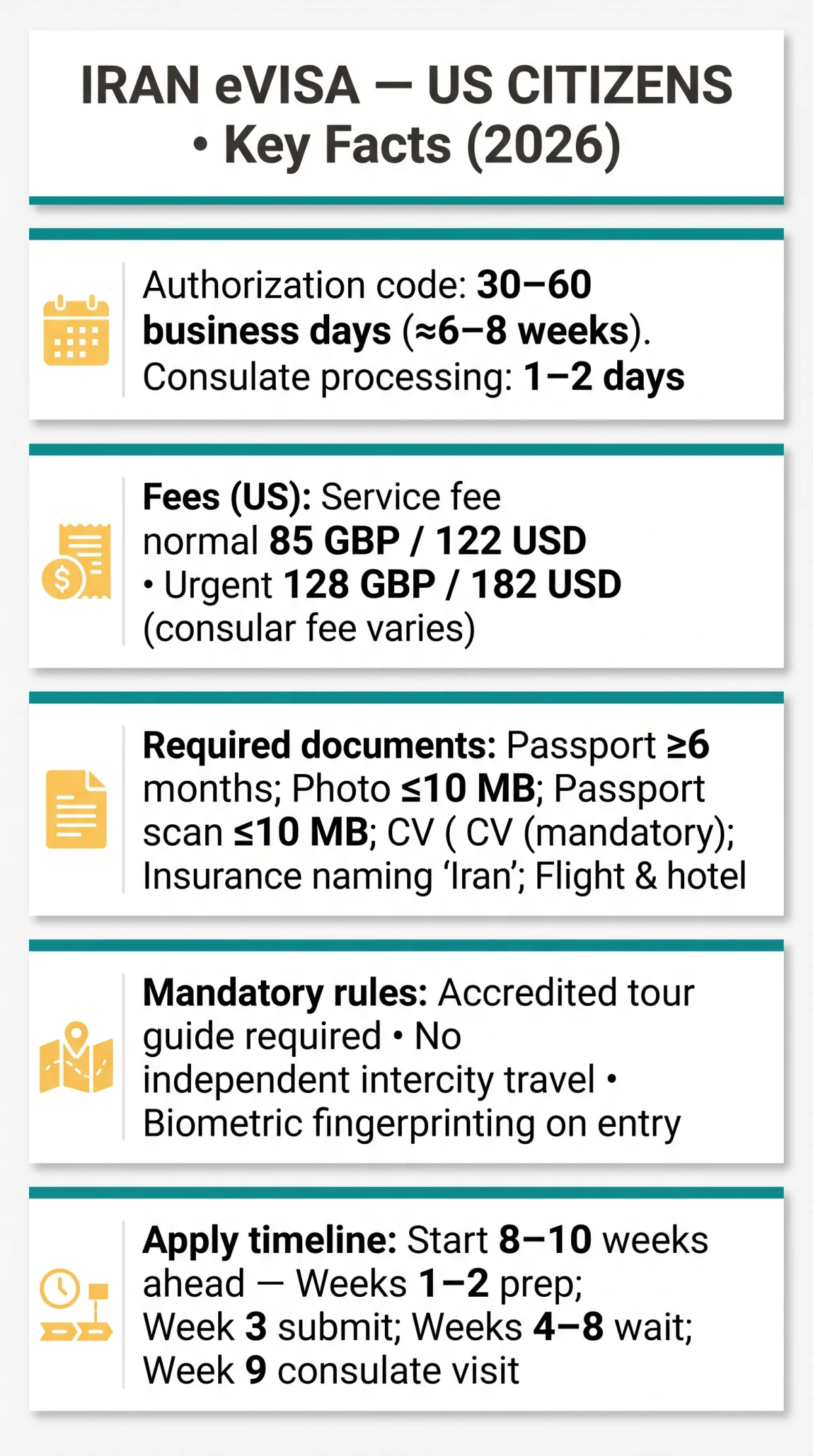
General eVisa processing takes 5-10 working days, but US citizens require 30-60 business days for authorization code issuance alone due to inter-agency security vetting (MFA). Additional US-specific requirements include a mandatory authorization code, a professional CV submission, and an accredited tour guide escort throughout the entire stay. Independent intercity travel is legally prohibited for US nationals.
US applicants maintain a 95% approval rate and account for 3.4% of total Iran visa applications globally. US citizens can and do visit Iran, provided they plan 8-10 weeks ahead and work with accredited Iranian tour operators.
Iran Visa Types and Which One US Citizens Need
US citizens pursuing the Iran eVisa primarily need the Type B tourist visa for leisure travel, offering a standard 30-day stay with a maximum of 90 days; visa on arrival remains unavailable to American passport holders.

The Iran eVisa for US citizens supports several visa categories. The Type B tourist visa covers tourism purposes and allows in-country extension. The Type A entry visa serves business travelers but requires a letter of invitation (LOI) from Iranian ministries, governmental organizations, or private and public sectors. The Type E education visa applies to foreign nationals enrolled at Iranian educational institutions.
An incorrect visa type triggers delays or refusal. US citizens are excluded from visa on arrival; the eVisa is the only electronic pathway. Travelers must confirm their category before submitting documents through the portal at evisa.mfa.ir or check visa types at evisatraveller.mfa.ir/en/request/visa_types/.
Other categories exist for medical treatment, pilgrimage, and journalism, each carrying distinct documentation requirements. US passport holders should verify the appropriate visa code on the MFA portal before beginning the application.
Passport and Document Requirements for US Applicants
The Iran eVisa for US citizens requires applicants to hold a passport valid for at least 6 months beyond their intended travel date. The electronic portal at evisa.mfa.ir automatically blocks applications that do not meet this passport validity threshold. US nationals must also submit a digital photograph with a plain light background (maximum file size 10 MB) and a complete, readable colour scan of their passport bio-data page. Photo specifications are detailed at evisatraveller.mfa.ir/en/request/digital_image_requirement/.
US applicants must submit a CV for security clearance. Travel insurance must explicitly state coverage for “Iran”, as generic worldwide policies are insufficient. If proper insurance is missing upon arrival, airport health insurance costs $18 USD or €14 EUR per person. The Iranian Embassy may also require 1-4 passport-sized pictures during consular processing.
| Document | Format | Notes |
|---|---|---|
| Passport bio-data page scan | Colour scan, max 10 MB | Must be valid for at least 6 months beyond entry date. |
| Digital photograph | Max 10 MB | Passport-style, plain light background. |
| Travel insurance policy | PDF document | Must explicitly state coverage for “Iran”. |
| CV/Resume | Plain PDF | Mandatory for US security vetting. |
| Flight itinerary | PDF document | Round-trip or onward ticket required. |
| Accommodation proof | PDF document | Hotel reservation or sponsor letter for full stay. |
How to Apply for an Iran eVisa – Step-by-Step Process
Register on evisa.mfa.ir, upload documents, pay fees, and await authorization code.
- Register on the MFA eVisa portal at evisa.mfa.ir or directly at evisatraveller.mfa.ir/en/request/applyrequest/ using your email and passport details.
- Select the Tourist visa (Type B) for leisure travel.
- Upload required documents: passport bio-data page scan, digital photograph (max 10 MB), travel insurance naming “Iran,” flight itinerary, hotel reservation, and CV/resume.
- Complete all personal information fields including employment, education, and travel history.
- Pay the visa fee. US-issued cards are commonly declined on Iranian payment gateways.
- Submit the application and receive a reference number for tracking.
- Wait for the authorization code from the MFA: 30 to 60 business days for US citizens. The code is valid for 30-60 days from issuance and must be collected within 60 days. It is valid only for the specific embassy designated in the application; forwarding to another consulate is available for an additional charge.
- Track your application using reference number (or passport number) + date of birth + email.
- Once authorized, schedule and attend a consulate visit or interview to complete the Iran eVisa for US citizens process. The embassy-issued tourist visa is valid for entry for 45 days from the issue date, with stay durations of 30, 60, or 90 days. Processing after the authorization code takes 1-2 days.
Where to Apply and OFAC Payment Restrictions
The Iran eVisa for US citizens requires all consular processing to route through the Iranian Interests Section housed within the Embassy of Pakistan in Washington, D.C., as Iran maintains no formal diplomatic mission on US soil.
| Fee Type | Amount | Currency | Notes |
|---|---|---|---|
| Service fee (normal, US citizens) | 85 / 122 | GBP / USD | 7-10 working days turnaround. |
| Service fee (urgent, US citizens) | 128 / 182 | GBP / USD | 3-5 working days turnaround. |
| Base service fee (normal) | 36.00 | EUR | General rate for other nationalities. |
| Base service fee (urgent) | 54.00 | EUR | General rate for other nationalities. |
| Consular visa fee | Varies | Local currency | Paid at consulate; separate from service fee. Non-refundable. |
Fee determinants include country of application, visa type, applicant nationality, and duration of stay. All fees are non-refundable upon rejection.
Because the Iran eVisa for US citizens involves payment through sanctioned Iranian gateways, US-issued debit and credit cards are routinely declined on the portal at evisa.mfa.ir. Viable alternatives include bank transfers through an intermediary, cash payment at the consulate, or pre-arranged agency-bundled payment through an accredited tour operator.
US citizens residing in the UK or EU can transfer their authorization code to a local Iranian diplomatic mission for an additional charge, enabling processing through embassies such as the Iranian Embassy in London rather than the Washington, D.C. channel.
Mandatory Guided Travel and Interview Procedures
The authorization code is tied to an accredited tour operator’s itinerary; a guide escort is a legal precondition for visa issuance. US applicants cannot deviate from the registered intercity route; independent overland travel between destinations is prohibited and can result in detention or deportation. Only minor date adjustments or activity substitutions within the same city are permitted.
The Iran eVisa for US citizens also carries a mandatory interview step for some applicants, as stated on the external government portal evisa.mfa.ir. Common triggers include defense, intelligence, or nuclear-related employment, prior military or government service, and Israeli travel history. US passports bearing Israeli entry or exit stamps face automatic visa refusal; renewing a passport removes visible stamps but does not erase MFA records. Interviews take place in-person at the Iranian Interests Section in Washington, D.C., or remotely via video call, typically after the authorization code is issued.
Unlike most nationalities whose passports are no longer physically stamped under Iran’s November 2018 policy (implemented by presidential order in June 2019 as a response to US sanctions on persons who visited Iran after 2011), US visitors may still receive physical stamps or endorsements upon entry.
Dual Nationals, Biometrics, and Visa Extensions
Dual US-Iranian nationals face conscription liability, while all US visitors undergo biometric fingerprinting and can extend visas in-country.
The Iran eVisa for US citizens does not override Iran’s treatment of dual nationals. Dual citizens of Iran and another country are counted as citizens of Iran upon entering the country and must use an Iranian passport, not a US passport. Male dual US-Iranian nationals face mandatory military service liability, with exemption categories limited and inconsistently documented.
The Iran eVisa for US citizens also entails mandatory biometric procedures at Iranian airports. US visitors undergo digital biometric fingerprinting at ports of entry, including Tehran Imam Khomeini International Airport (IKA). Refusal to provide fingerprints carries entry-denial consequences.
Tourist visas can be extended inside Iran through the Police Department of Foreign Aliens Affairs, available in any major Iranian city. This in-country extension option applies to tourist visas, though the exact number of permitted extensions and associated costs are not specified in available sources.
Tips to Improve Your Iran eVisa Approval Chances
Apply 8-10 weeks ahead, match itinerary to tour plan, audit social media.
- Apply 8-10 weeks before travel. The Iran eVisa for US citizens requires 30-60 business days for authorization code issuance alone.
- Submit a complete, accurate CV. Employment history and military declarations must match your application answers exactly.
- Match your itinerary to the registered tour plan. The Iran eVisa for US citizens is legally bound to an accredited tour operator’s route; deviations can trigger denial.
- Renew your passport if Israeli stamps are present. Evidence of travel to Israel triggers automatic visa refusal.
- Arrange payment via bank transfer or agency-bundled payment; US cards are declined on Iranian gateways due to OFAC sanctions.
- Audit social media profiles. Public posts about Iran, US foreign policy, or Israel can trigger denial during security clearance.
- Double-check all uploaded documents. Passport scans and digital photos must be legible and within the 10 MB file size limit.
Week 1-2
Document prep
Week 3
Submission
Week 4-8
Wait and follow-up
Week 9
Consulate visit
Week 10
Pre-departure
Disclaimer: This portal is an independent travel information resource and does not represent the Iranian government. All visa applications must be submitted through the external MFA portal at evisa.mfa.ir. We may earn commissions from accredited tour operators mentioned in this guide.
FAQ: Iran eVisa for US Citizens
Can US citizens get a visa for Iran in 2026?
Yes. US citizens must apply for a Type B tourist visa through the MFA eVisa portal with a mandatory authorization code and accredited tour operator. Visa-free entry is not available for US nationals.
How long does the Iran eVisa take for US citizens?
30 to 60 business days for the authorization code, plus 1-2 days for consulate processing after the code is issued. The extended timeframe is due to inter-agency security vetting.
Do US citizens need an interview for an Iran visa?
Yes, for some applicants. Triggers include sensitive professions, past military or government service, prior Iran travel, or Israeli travel history. Interviews are conducted remotely or in-person at the Iranian Interests Section in Washington, D.C.
How much does an Iran eVisa cost for US citizens?
The service fee is £85 (US$122) for normal processing or £128 (US$182) for urgent. The consular visa fee is separate and paid at the consulate. All fees are non-refundable, and US-issued cards are declined on Iranian gateways.
Can US citizens travel independently in Iran?
No. The authorization code is legally bound to an accredited Iranian tour operator’s registered itinerary. Independent intercity travel is prohibited and can result in detention or deportation.
What happens if my Iran visa application is denied?
All paid service and consular fees are non-refundable. Common causes include incomplete submissions, inconsistent personal details, or undeclared government employment. Applicants must reapply if rejected.
Can I get a visa on arrival in Iran as a US citizen?
No. US citizens are excluded from the Visa on Arrival program. The eVisa application through the MFA portal is the only electronic pathway available.
Do I need travel insurance for an Iran eVisa as a US citizen?
Yes. Insurance must explicitly state coverage for “Iran”; generic worldwide policies are insufficient. Airport fallback insurance costs $18 USD or €14 EUR per person if proof is missing on arrival.
Can US citizens with Israeli stamps in their passport get an Iran visa?
No. Israeli entry or exit stamps, or evidence of travel to Israel via Jordan or Egypt land crossings, trigger automatic visa refusal. Passport renewal removes visible stamps but does not erase MFA records.
Where do I physically submit my Iran visa application as a US citizen?
Through the Iranian Interests Section at the Embassy of Pakistan in Washington, D.C. US citizens residing in the UK or EU can transfer their authorization code to a local Iranian diplomatic mission for an additional charge.